7 Common Office Exit Coordination Problems Sydney Businesses Miss Before Handover
Sydney Office Clearance Team
Commercial Office Clearance Specialists
- •Your team still has a business to run: chasing separate removalists, building managers, painters, and cleaners pulls leadership and office managers away from daily operations.
- •Commercial building managers control dock access, goods lift reservations, and security paperwork that cannot be arranged at the last minute.
- •Office clearance (furniture and loose items) and lease make-good (repainting, wall repairs, partition restoration) are separate scopes that require sensible sequencing.
- •Wall fixtures, TV brackets, signage, decals, and adhesive residue are frequently overlooked until the final landlord walkthrough.
- •Keeping clear after-photos of agreed cleared spaces gives tenant management reliable proof of physical completion for corporate records.
When a commercial lease expiry or office relocation approaches, most operations and office managers focus on the obvious task: getting unwanted desks, chairs, and cabinets out of the tenancy. However, physical clearance is only one component of an office handback. Meanwhile, your team still has a business to run. Instead of coordinating clearance crews, building access, painters and cleaners separately, understanding where handbacks stall, and how to manage the physical office exit through one point of contact, prevents last-minute handover friction.
1. Leaving the Building Manager Until the Last Minute
In multi-tenant commercial office buildings across Sydney CBD, North Sydney, Parramatta, and Macquarie Park, facilities and building managers enforce strict building management protocols. They are responsible for protecting common property, managing tenant traffic, and ensuring building security.
Depending on the specific building management rules, building managers may control basement loading dock access, vehicle size and height limitations, loading bay duration limits, goods lift reservations, security access cards, and contractor sign-in processes.
Contacting building management just 24 to 48 hours before your lease expires often leads to scheduling conflicts. If another tenant is moving in or a major fitout contractor has already reserved the loading dock, your clearance team may be refused entry, putting your lease deadline at risk.
Office Exit Management Sydney
See how Sydney Office Clearance manages the physical office exit, including dock access documentation, clearance, minor make-good, and exit cleaning, through one point of contact.
2. Assuming the Goods Lift or Loading Dock Will Simply Be Available
A widespread misconception is that commercial clearance vehicles can simply drive into a building loading dock at any time and roll office furniture into standard passenger lifts.
Passenger lifts in commercial office towers are strictly prohibited from carrying heavy commercial desks, bulky compactus units, and metal storage cabinets. All furniture transit must occur via designated service or goods lifts.
In major Sydney commercial precincts, including towers managed by institutional landlords such as Mirvac, Dexus, GPT, or Charter Hall, goods lifts operate on strict reservation registers, typically booked on a first-come, first-served basis. Furthermore, building management usually requires protective curtains and floor runners to be installed before any furniture movement commences.
- •Goods lifts are often shared across 20 to 50 corporate tenancies and major food/retail delivery vendors.
- •Loading dock clearances vary by building, requiring vehicle dimensions and access rules to be confirmed prior to job dispatch.
- •Some buildings require vehicle turntables to be operated only by dock master staff during specific operating windows.
Sydney CBD Office Clearance Services
Review high-rise access requirements and lift coordination for Sydney CBD commercial towers.
3. Not Confirming Access Paperwork and Vehicle Details Early
Building managers have a duty of care to ensure all contractors working on-site carry valid insurance and follow safety procedures. Before allowing clearance personnel or vehicles on site, building concierges routinely mandate specific documentation.
Standard requirements include a current Certificate of Currency for Public Liability Insurance (PLI), typically with a minimum of $20 million coverage, together with nominated driver names, mobile contacts, vehicle registration numbers, and completed contractor safety inductions.
At Sydney Office Clearance, we support access documentation by providing our public liability documents and driver/vehicle details for the agreed physical clearance scope once confirmed. However, tenants must ensure this paperwork is submitted to their building manager within the building’s designated notice window.
4. Treating Office Clearance and Make-Good as the Same Thing
One of the most expensive misunderstandings in commercial tenancy handovers is conflating physical office clearance with lease make-good obligations.
Physical office clearance is the removal of agreed freestanding furniture (desks, ergonomic chairs, workstations, pedestals, meeting tables), loose contents, and obvious e-waste. Lease make-good, by contrast, refers to the contractual handback condition specified in your commercial lease agreement.
Under NSW commercial leasing principles, make-good requirements depend entirely on the covenants negotiated in your specific lease contract and any initial ingoing property condition reports. Potential obligations may include removing internal partitions, repainting perimeter walls to base-building colour codes, replacing damaged ceiling tiles, or restoring modified lighting circuits.
Tenants should never assume that an empty office automatically satisfies lease make-good requirements. Always review your lease covenants carefully and consult your tenant adviser or legal counsel where necessary.
Lease Handover Office Clearance Sydney
Understand how physical clearance integrates into your broader lease exit timeline.
5. Forgetting Walls, Holes, Signage, Decals, and Branding
When furniture is cleared away, the condition of the tenancy’s walls, glass partitions, and doors is suddenly exposed. Commercial tenants frequently overlook minor fixtures and branding elements until the final landlord walkthrough inspection.
Typical physical items left behind include: wall anchors and screw holes from removed wall-mounted TVs, video conferencing bars, whiteboards, floating shelves, acoustic panels, and picture frames. Additionally, illuminated reception signage, acrylic logo panels, vinyl wall graphics, and frosted privacy film on meeting room glass often leave heavy adhesive residue.
Whether these items must be removed and the surfaces patched or repainted depends strictly on your lease agreement and agreed handback scope. Where requested, Sydney Office Clearance can include agreed minor patching, touch-up painting and signage removal in your coordinated office-exit scope.
6. Leaving Cleaning and Specialist Trade Work Until the Final Day
Attempting to perform commercial carpet cleaning, wall painting, data cabling de-termination, and furniture dismantling all on the final day of your lease creates operational chaos and increases the risk of damage to freshly cleaned or painted surfaces.
Your team still has a business to run, and you do not have to become the project coordinator for your own office exit. Approve the scope. Introduce us to building management. Give us the agreed site access. We coordinate the physical office exit from there.
A logical and stress-free office exit follows a structured sequence: First, conduct the physical office clearance to remove all agreed furniture and loose items. Second, inspect the exposed walls, floors, and ceiling tiles against your handback scope. Third, carry out agreed wall patching and repainting. Fourth, execute the final commercial vacate clean. Sydney Office Clearance remains your main point of contact across clearance, make-good, cleaning, specialist trades, access and completion records.
- •Physical Office Clearance: Clear all agreed workstations, seating, loose items, and obvious e-waste.
- •Exposed Area Inspection: Check for previously concealed wall holes, damaged tiles, or floor stains.
- •Agreed Make-Good & Trade Works: Coordinate wall patching, repainting, or licensed trade providers as required.
- •Commercial Vacate Clean: Steam extract carpets, wipe skirtings, and detail kitchenettes once trades have departed.
- •Completion Records: Capture after-photos ahead of your final building management walkthrough.
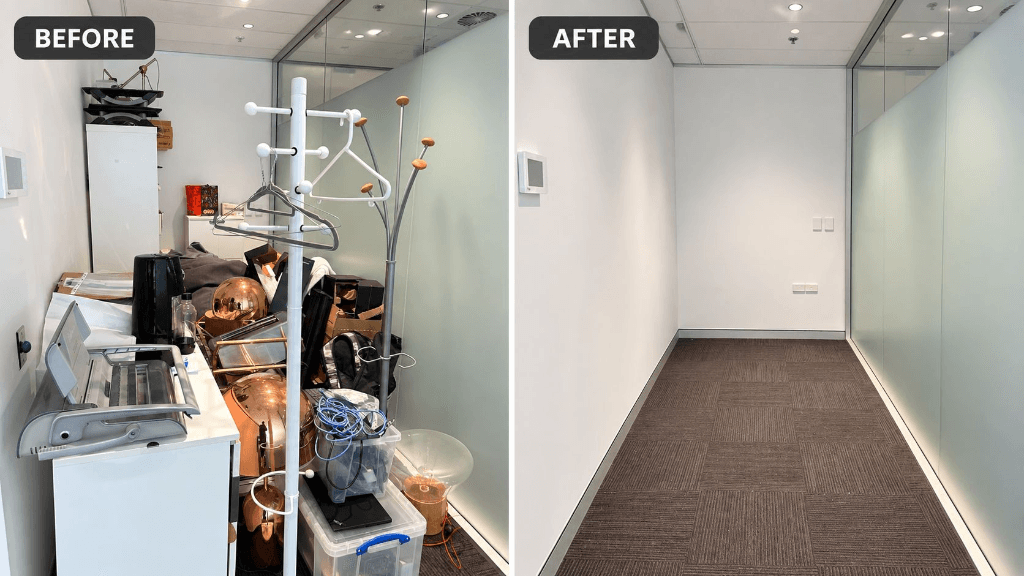
Recent Sydney CBD office exit, Circular Quay
Agreed selective clearance (retaining approved landlord items and removing a nook cupboard and loose items), coordinating goods lift booking windows and weekend painting around shared HVAC rules, followed by wall make-good/repainting and commercial exit cleaning through one point of contact.
Comparing every contractor separately may save a little on individual jobs, while costing your team hours of coordination. Sydney Office Clearance gives you one main point of contact across the physical exit.
7. Finishing the Physical Work Without a Photographic Record
Once physical clearance is complete and keys or access fobs are returned, dispute resolution becomes significantly harder if you do not possess contemporary evidence of the state in which you left the premises.
Property managers and incoming tenants may raise questions days or weeks after handback regarding items left behind or alleged damage to common areas. Having clear, high-resolution after-photos of all cleared office suites, server cupboards, and loading dock pathways provides clear corporate records.
At Sydney Office Clearance, we provide after-photos of all agreed cleared physical areas as standard practice, giving your facilities and finance teams tangible proof of project completion.
Planning a Smooth Office Exit in Sydney
A successful commercial office exit is not achieved simply by calling a general removalist at the eleventh hour. Your team still has a business to run, and instead of pulling operations staff away from core work to chase separate contractors, Office Exit Management gives you one main point of contact across agreed clearance, building access documentation, minor make-good, and commercial exit cleaning.
If your business is preparing to move out, downsize, or hand back commercial office space in Sydney, send your office photos or a video walkthrough to Sydney Office Clearance for a scope-locked, photo-reviewed quote.
Author & Operational Scope Note:
Sydney Office Clearance specialises in physical commercial office clearance for agreed furniture, loose items, and obvious e-waste, providing after-photos for corporate records. We support access documentation (PLI documents and vehicle details) for confirmed projects. We do not provide legal advice, building management certification, or lease sign-off. Commercial lease covenants vary; consult your tenant representative or legal counsel for lease-specific interpretations.
More Commercial Exit Guides
Explore additional operational resources for Sydney office moves and handovers.
Office Make-Good in NSW: Wall Holes, Signage, Stickers, Partitions & Painting
What does make-good mean in NSW commercial leases? Learn how wall fixings, removed signage, vinyl decals, partitions, and painting are practically handled before lease handback.
Sydney CBD Office Clearance Access Checklist: Goods Lift, Loading Dock & Building Manager
Navigating high-rise building logistics in Sydney CBD requires strict compliance with loading dock rules, goods lift reservations, and security paperwork. Use this practical access checklist.
Office Furniture Removal Before Lease Handover: What Should Be Scoped First?
Avoid unexpected handover costs by scoping your office furniture correctly. Learn what items to assess first, fixed vs freestanding assets, and photo quote preparation.
Ready to Clear Your Sydney Office?
Send us your office photos or a video walkthrough for a scope-locked, photo-reviewed quote before your lease handover deadline.